Fraunhofer Gesellschaft Alzenau

Climate and air management for laboratories and offices
Minimal energy consumption for exhaust air control
Since the integration of various building services had to be combined into a complete solution and the planner had specified reliable air conditioning for the nine laboratories, our system partner—the Erfurt-based company ASE—chose the DEOS system for this project. The DEOS building automation system controls all of the heating, ventilation, and air conditioning systems in the institute’s new building and monitors everything using the locally installed DEOS GLT OPENweb.
Thanks to DEOS’s expertise and many years of experience gained from numerous practical building projects, ASE was able to meet these individual customer requirements with the help of DEOS solutions.
This has made working with hazardous substances in the laboratory safer, as greater attention has been paid to the exhaust air control of the installed digesters (laboratory extraction systems for handling volatile hazardous substances): when the protective screen of these extraction systems is opened, the air volume is automatically increased.
In this project, the energy consumption of this exhaust air control system in particular had to be made as efficient as possible, as did the conscious use of space for the entire building.
The DEOS control system adds up the individual requirements of the extraction systems and regulates the central exhaust air system as needed. Our long-standing DEOS system partner ASE supported the end customer in the design and functional creation of this special exhaust air system and, as integrator, also took on the installation and programming of the DEOS building automation system.
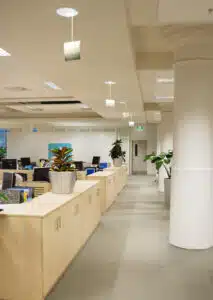
The open structure of the new building creates a very communicative atmosphere. Despite the open-plan design, the tender specifications stipulated sustainable heating and cooling generation and utilization. For this reason, the supply air system was combined with a heat recovery system including BACnet IP communication to ensure optimum energy efficiency.
The DEOS GLT OPENweb installed on site centrally records all (almost 10,000) TGA fault messages for the entire building. The operating personnel can configure the system to determine which TGA system fault messages are to be displayed on the GTL. For energy monitoring, the energy meters were connected to the GLT via M-Bus. This allows energy reports to be generated and the development of space consumption to be monitored.
In order to avoid basing the control of the heating/cooling system solely on the actual data from the outdoor sensors, the DEOS control system in Alzenau was combined with a predictive control system based on local weather forecasts. This allows the building services system to respond early to future weather conditions and regulate temperatures in the building in a forward-looking manner. With this intelligence in the building, the control system is always one step ahead, saving valuable energy.
In order to avoid basing the control of the heating/cooling system solely on the actual data from the outdoor sensors, the DEOS control system in Alzenau was combined with a predictive control system based on local weather forecasts. This allows the building services system to respond early to future weather conditions and regulate temperatures in the building in a forward-looking manner. With this intelligence in the building, the control system is always one step ahead, saving valuable energy.
Interest aroused?
Then contact us! We’re glad to help.